
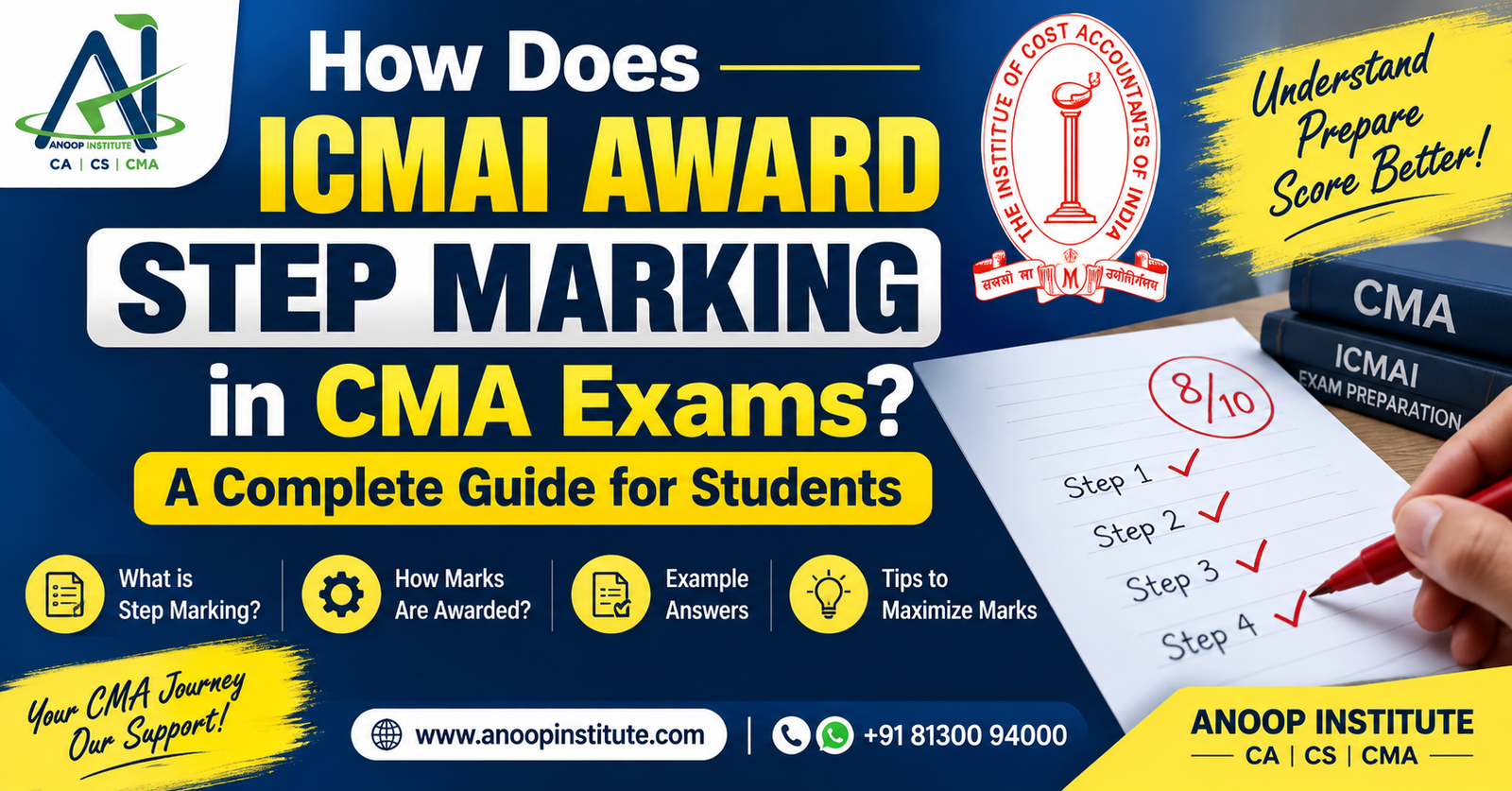
Many CMA students lose marks not because they don't know the concept, but because they don't know how ICMAI's evaluation system actually works. One of the most important — and most misunderstood — parts of this system is step marking.
What is Step Marking?
Step marking (also called stepwise marking) is a marking method where examiners award marks for each correct step in a solution, rather than only checking whether the final answer is correct. This is especially important in CMA papers that involve numerical problems — such as Cost Accounting, Financial Accounting, Direct and Indirect Taxation, Financial Management, and Costing & Financial Management.
Under this system, if a student:
- Identifies the correct formula or approach
- Applies the correct method
- Shows correct intermediate calculations
- But makes a small error in the final step (like a calculation slip)
...they can still score a significant portion of the marks for that question, because each correct step along the way is evaluated and rewarded individually.
Why ICMAI Follows Step Marking
ICMAI's exams are designed to test a candidate's understanding of concepts and their practical application — not just the ability to arrive at a final number. Since Cost and Management Accounting involves multi-step calculations (like process costing, standard costing, variance analysis, or marginal costing), a single arithmetic slip shouldn't erase all the effort and correct reasoning shown earlier in the solution. Step marking ensures fair evaluation of a student's actual knowledge and process.
How Step Marking Typically Works in Practice
While the exact mark allocation is decided by ICMAI's evaluators as per the marking scheme circulated for each paper, the general pattern followed is:
- Correct identification of the problem type – Some marks for correctly recognizing what the question is asking (e.g., identifying it as an EOQ problem or a break-even analysis).
- Correct formula/method – Marks for writing and applying the right formula or approach.
- Correct working/calculation steps – Marks for each accurate intermediate step, such as sub-totals, adjustments, or workings shown separately.
- Final answer – The remaining marks are allotted for arriving at the correct final figure.
This means that even a partially correct answer, if the steps and workings are clearly shown, can fetch a good percentage of the total marks for that question.
Tips to Maximize Step Marks in Your CMA Exam
- Always show your workings — Never write only the final answer. Show every calculation, formula, and adjustment clearly.
- Label your steps — Use headings like "Step 1: Calculation of Contribution" so the examiner can easily follow your logic.
- Write the formula before applying it — This ensures you get marks for knowing the correct approach, even if the final number is off.
- Present workings neatly in a separate column or box — Many CMA papers expect workings to be shown distinctly from the main answer.
- Don't leave numerical questions blank — Attempting a question with correct steps, even if incomplete, is far better than leaving it unanswered.
- Practice with model answers — Compare your solution structure with ICMAI's suggested answers to understand how examiners expect steps to be presented.
Why This Matters at Anoop Institute
At Anoop Institute, we train CMA students not just to understand concepts, but to present them in a way that aligns with ICMAI's evaluation pattern. Our faculty focuses on answer-writing techniques, proper presentation of workings, and step-by-step problem-solving practice — helping students secure every possible mark, even under exam pressure.
Conclusion
Understanding step marking can be the difference between a pass and a fail, especially in numerical-heavy CMA papers. By focusing on clear, well-labeled workings rather than just chasing the final answer, students can significantly improve their scores. For personalized guidance on answer-writing strategy and exam preparation, connect with Anoop Institute's expert CMA faculty.
(Note: Exact mark distribution for step marking may vary paper-to-paper as per ICMAI's official marking scheme. Students should refer to ICMAI's official guidelines and model answers for the most accurate, paper-specific details.)